
AI x Utilities: Practical lessons from utilities around the world

Senpilot
HANDBOOK
AI x Utilities:
Practical lessons from utilities around the world
senpilot.com
Introduction
The 2026 edition of the AI x Utility Handbook brings together insights that matter most to daily operations at utilities worldwide and particularly where AI investments are producing tangible returns. These practical lessons are shaping utility strategy, performance, and innovation. Utilities must leverage these insights to keep pace with the accelerating rate of change. These changes are shaping how the industry will operate going forward.
Where Senpilot fits into the AI transformation
As these changes accelerate, Senpilot has become a central partner to utilities navigating this transition and is recognized as the leading AI-for-Utilities provider globally, earning multiple industry awards. Additionally, Senpilot was the first to deliver an agentic engineering system purpose-built for utilities.
Senpilot’s work covers investor-owned utilities, municipals, co-ops, and system operators worldwide.
A strong background in AI applications
The team combines deep utility expertise with a distinguished background in AI, drawing talent from organizations such as NVIDIA, Uber, Carta, Airbnb, Apple, and AMD. This blend of operational understanding and technical capability enables Senpilot to help utilities move beyond experimentation and deploy AI that works in real operational environments. Through thought leadership, speaking engagements at conferences, and direct collaboration with utilities of all sizes worldwide, Senpilot continues to collect and share insights that are shaping the industry’s next chapter.

Mike Hejmej
CEO
Bain management consultant, Airbnb strategist, now Senpilot CEO.



Alex Peats-Bond
CTO
NVIDIA engineer, Uber infrastructure veteran, now Senpilot CTO.


The emerging era of Agentic AI
The previous year saw a step change in the AI industry. Typically, these significant changes in AI and its applications occur yearly, or in some cases, every six months. Closing out 2025, however, these changes occurred weekly and have significant downstream impacts on the utility industry. The most impactful change in AI is the emergence of AI agents and agentic flows.
According to a Gartner study,
By 2028, 33% of enterprise software applications will include agentic AI, up from less than 1% in 2025, enabling 15% of day-to-day work decisions to be made autonomously.
At Senpilot, we expect to exceed the 50% threshold by 2030.
The AI excitement is real, and the benefits are simply astounding:
WHY IS EVERYONE SO EXCITED ABOUT AI?
Changes like these often originate in the Bay Area. They are quickly making their way into the Finance, Banking, Legal, and Software sectors and are becoming more visible and applicable in the Energy sector. In utilities, adoption of new AI technologies remains below 6%, but is expected to reach 25% in 2026.
A few of these breakthroughs that are starting to maketheir way into the industry include:
| BREAKTHROUGH | WHAT HAPPENED | WHY IT MATTERS TO UTILITIES |
|---|---|---|
| Agents | Tool calling was invented as a novelty, but became extremely practical and effective. | AI agents plan, act and reason with tools to complete a process autonomously. |
| New image models | Drastically improved (see Gemini Nano Banana Pro) | Will unlock design-based workflows, improve autonomous checks in the field, and more visually-based reasoning use cases |
| Improved reasoning | Evals skyrocketed as reinforcement learning continued to scale | Agents and tools will have deeper, longer thinking for harder use cases |
Getting started with AI Agents
To get you more familiar with AI agents, here are three immediate ways to understand their power and how you can aim to leverage them day to day:
| TASK | HOW TO LEVERAGE AN AI AGENT | OUTCOME | TANGIBLE EXAMPLE TO TRY |
|---|---|---|---|
| Ideation | Ask agents to think through all scenarios to help you ideate and validate any new and existing ideas you need to test | Agents are excellent at creating, ranking and structuring ideas with minimal input by leveraging tool calling to do so | Loveable: Create a mock restaurant website about your favourite food with a few prompts to see what tools and how an agent puts it all together [15 MINS] Try Lovable |
| Expertise | You don’t have to be the expert; agents can synthesize and provide expertise | No need to wait weeks for answers from teams and SMEs, agents have infinite other agents at their disposal | Claude: Attempt to make an Excel model that is a simple forecast of the amount of electricity growth in your home region [20 MINS] Try Claude |
| Workflows | Place an agent to act as a human in a very repetitive workflow | Have an agent handle consistent tasks with the information you feed it and watch it get smarter every day | Elevenlabs: Create a voice agent that acts like your personal secretary and screens all the calls you get from unknown numbers [50 MINS] Try ElevenLabs |



Leading AI use cases in utilities
A few of the top use cases for AI in Engineering, Customer Service and Regulatory.
| FUNCTION | AI USE CASE | EST VALUE (per 1M homes) | POPULARITY AMONG UTILITIES |
|---|---|---|---|
| Eng | Asset failure prediction (failure curves) | $55M | ★★★★★ |
| Reg | Pre-empt IRs to strengthen the application | $15M | ★★★★★ |
| Eng | Continuous data cleanup (GIS, AMI, SCADA) | $19M | ★★★★★ |
| CX | Support during extreme weather & emergency events | $45M | ★★★★★ |
| Reg | Cross-jurisdiction precedent and data gathering | $13M | ★★★★★ |
| Eng | Project discovery for clusters of work | $76M | ★★★★★ |
| CX | Credit, payment, and assistance program guidance | $18M | ★★★★★ |
| Eng | Identify the most cost-effective grid-hardening investments | $33M | ★★★★★ |
| Reg | Create business cases using precedents both in-state and with other regions | $18M | ★★★★★ |
| Reg | Pre-draft asset condition & load forecast narratives | $27M | ★★★★★ |
| CX | Customer service agent & AI support layer | $24M | ★★★★★ |
| FUNCTION | AI USE CASE | EST VALUE | POPULARITY AMONG UTILITIES |
|---|---|---|---|
| Eng | Demand planning suggestions | $8M | ★★★★ |
| Eng | Improved work order management | $5M | ★★★★ |
| Eng | AMI-based transformer health and performance (active transformer load, voltage, temperature) | $23M | ★★★★ |
| Reg | Check for cross-exhibit claim & narrative consistency | $21M | ★★★★ |
| Reg | Witness preparation support | $9M | ★★★★ |
| Reg | Analyze decision, recompute revenue & rates, and propose subsequent actions | $36M | ★★★★ |
| CX | Meter issues & tamper investigation support | $5M | ★★★★ |
| CX | Storm surge triage & outage communications | $6M | ★★★★ |
| CX | Customer sentiment insights for operational feedback | $2M | ★★★ |
Industry events featuring Senpilot
We’ve spent 2025 touring utilities worldwide, from large IOUs to smaller cooperatives, learning from everyone we spoke to at the following conferences.
A big thank you to everyone for sharing learnings, it’s the only way we can really move the industry forward.
 Distributech
 NRECA
 CEATI
 EDA
 Electricity Canada
 Grid Forward
 APPA
 MEA
 EEI
 POWERGEN
Major failure cases from 2025 (anonymized)
Before diving into the key learnings from 2025, it’s essential to address the biggest flops we have seen utilities make in implementing AI over 2025, across a collection of co-ops, municipality owned, and investor owned utilities. Hopefully, this helps you from making the same mistake.



Utility Co
The utility that tried to do everything, all at once
In January 2025, the Utility Co. CEO announced that they would have “the most robust AI program in the industry.” The hunger was real across hundreds of integrated use cases, including predictive maintenance with failure curves, automated customer care, outage prediction and field-crew routing. All this was to be launched across a majority of the organization in a short 2-year window.
On paper, it looked visionary. In practice, it became a slow-motion burn and collapse. Each department spun up its own AI experiments and use cases, resulting in hundreds of vendor demos. Pilot projects were launched weekly, many without clear success criteria or data readiness. Utility Co. had an internal AI team that prioritized use cases across the organization, but this became a bottleneck for approvals. IT pushed back on security risks. Operations struggled to integrate early prototypes. The executive team began requesting ROI reports, but no one had the data to produce them.
By Q3 of 2025, the initiative had stalled, with 27 pilots running but none in production. The internal narrative shifted from “AI will transform us” to “AI doesn’t work here.” Utility Co. didn’t fail because it lacked talent or budget; it failed because it tried to scale before it had learned about the key use cases it needed to tackle.
LDC Co
The utility that waited for the golden use case
LDC Co. took the exact opposite path to Utility Co. LDC Co. executives knew AI mattered, but were risk-averse. They avoided pilots and investments until they were absolutely sure. Their position was consistently to start only when they found a proven, mature use case guaranteed to deliver savings.
Throughout 2025, utilities across their peer group deployed AI in vegetation planning, customer operations, GIS enrichment, and non-wire alternatives forecasting. LDC Co monitored them all closely but chose not to act as they were still “too early stage” to show concrete results. They believed a fully validated, perfect use case would eventually emerge, allowing them to select it and proceed. This magical use case never showed up.
By the end of the year, the LDC Co. found itself years behind its peer utilities. Vendors were now pricing AI products for mature buyers. Worst of all, staff had developed AI anxiety, convinced the organization had already missed the wave. No one internally was excited to try any new technology or AI. With increased workloads per worker in utilities and an aging workforce, this inaction compounded the anxiety.
DSO Co
The strategy committee that spent two years producing… governance
In January 2024, DSO Co. established an AI Strategy Committee. The committee included operations leaders, IT, cybersecurity, regulatory affairs, and a newly appointed Head of AI. Their mandate was to define a comprehensive AI strategy for the DSO Co.
By early 2026, the committee had produced exactly one deliverable: a detailed governance framework. It wasn’t a useless output as governance is foundational, but it was the only output. The committee had spent two years reviewing policy documents, debating risk frameworks, scoring AI vendors, and hosting workshops. Meanwhile, the real operational work was underway outside the committee: IT and cybersecurity were already building guardrails, and business units were launching AI experiments independently.
When DSO Co finally tried to implement its governance framework, it discovered IT and cybersecurity had already built a more practical version months earlier. With time running out and executive pressure mounting, the utility took a shortcut and purchased an external AI system with limited flexibility. Ultimately, this resulted in two years of meetings, high OPEX, and no competitive advantage.
Key lessons shaping the utility sector
Lessons learned from the top utilities in the world.
The build vs. buy decision
This is often the first question or pushback we get from innovation teams at utilities. Many want to explore building AI internally. A few forward-thinking utilities understand why there is a shift toward buying prebuilt AI infrastructure.
To be clear, we aren’t aiming to bias you because the truth is that both approaches can work, but not equally well in every case.
Over the past few years, we’ve seen many utilities attempt to build internal AI from scratch. Most of the time, the cost, complexity, and upkeep are tremendously underestimated. Building an AI system from scratch requires ongoing resources for model training, infrastructure, maintenance, and continuous retraining. Compared to other technology investments, the cost is similar to building your own AMI Head or GIS platform. Why do it?
At GridFWD 2025, we heard that many utilities still want to build AI internally at least once. The motivation isn’t purely technical. There is a cultural component. Teams want to understand what “AI” really means, what’s possible, and how these models behave with their own data. This experimentation builds trust and literacy within the organization, even if the pilot never scales.
A new best-in-class practice has emerged, and it isn’t “build or buy.” It’s build and buy. A balanced approach is where utilities buy the foundational AI model and infrastructure, ensuring security and regulatory compliance are handled. From there, internal teams can build lightweight AI use cases on top of it. This is often done with an external vendor. Adding unique business logic that reflects their own operations.
The best way to think about this is that the platform is bought, but the creative use cases stay in-house. This hybrid model avoids the cost of full-scale internal development while still encouraging cross-departmental innovation for the utility’s unique use cases.
Rethinking open source in utilities
When discussing buy vs. build, one related question always arises: What about open source? How will that play into this? Historically, open source made everyone nervous. The term carried connotations of heavy risk and privacy issues. In 2026, however, open-source AI models have reached a point where they often exceed closed models. For most utility workflows, they are more than good enough. They are an efficient option.
When appropriately deployed, open source models can enhance data security. Running these models in your own environment ensures that no external systems access your data. The entire process, from data ingestion to model inference, remains under control. This makes open-source AI especially attractive for utilities, where data containment is always top of mind.
It’s worth noting that even the most security-sensitive industries, such as global law firms, are now trusting open source enterprise AI partnerships. They’re relying on binding clauses to ensure that the models do not train or leak their data.
For utilities and other industries that are still lagging, it’s now clear that open source isn’t risky. It means more control and a step closer to being AI-first.
Building an AI-ready culture
Building an AI culture takes time and often feeds directly into the build vs. buy dilemma. We’ve seen both sides of this: the flywheel of growth as well as the flat-footed flop.
Some utilities have created a culture of growth that compounds further through the adoption of enterprise AI licenses, enabling their teams to thrive. What typically follows is excitement, and best of all, it creates a flywheel that encourages everyone to experiment. The first thought all teams should have as we move into a more AI-native world is: “How can I leverage AI to do what I’m about to do?”
Some utilities, however, flop here by immediately blocking the use of ChatGPT and other tools. Ultimately, the utility suffers because the culture of embracing this change dies. If only a few champions within a utility are pushing for this change, and a majority are against or indifferent, AI culture will flop.
Two standout examples of an excellent culture we’ve seen are at Southern Company and Eversource. Their regulatory teams embraced AI, and throughout the year, we saw strong demos and panels showcasing their progress at all the conferences we attended. They’ve seen nearly 10x efficiency in regulatory work. Their stories prove what’s possible when a utility doesn’t just install new tools but builds a culture around them.
Common questions from HR teams
HR folks often ask us two valid and forward-looking questions:
- 1.What do entry-level roles of the Utility org look like in 2030?
- 2.What new roles will be needed as AI advances?
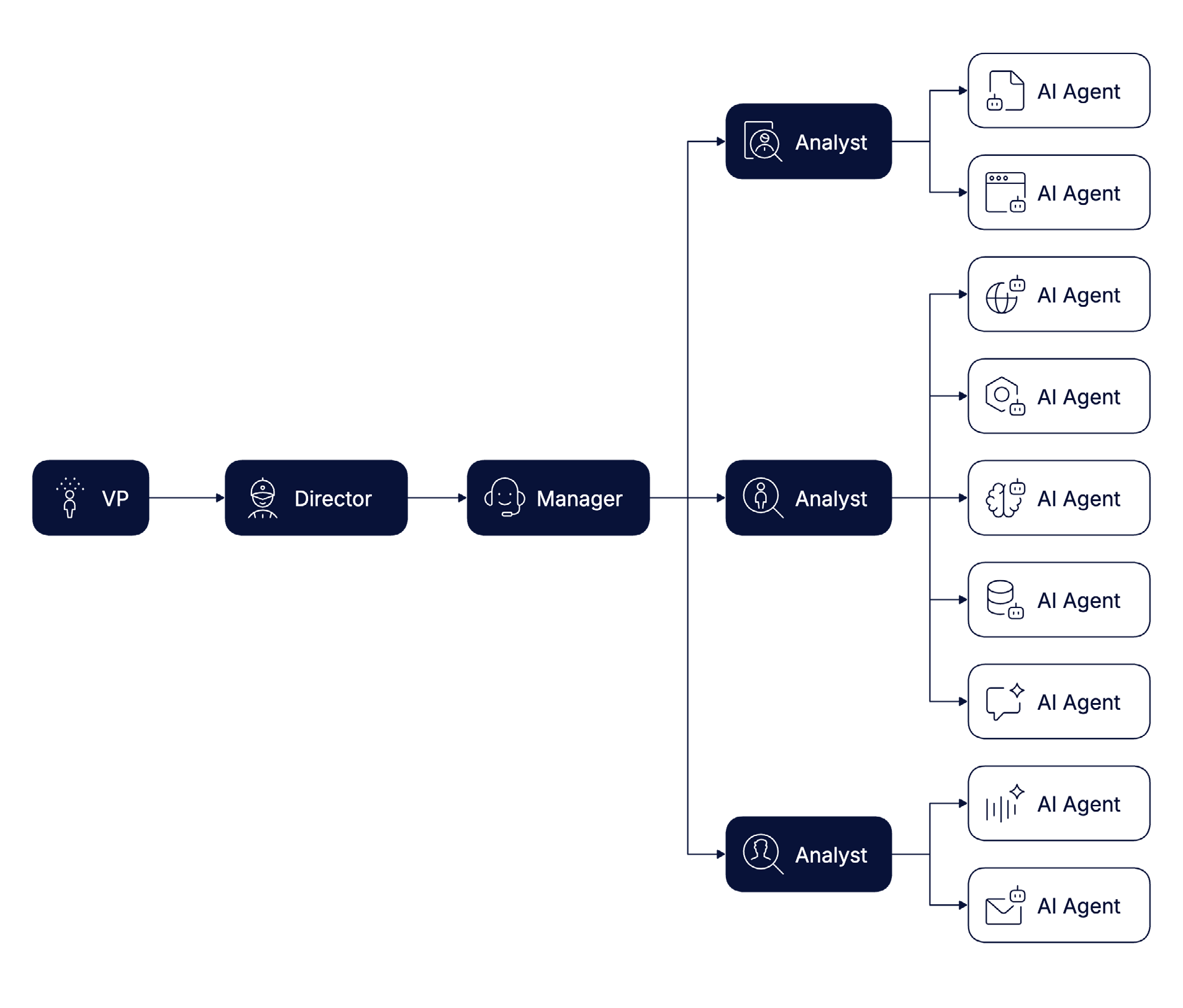
For the first question, we’re seeing a clear shift: the analyst level is becoming the operator level. The most junior employees will manage AI agents, much like managers, but not human employees. Their focus will be on monitoring, training, and directing these agents across tasks. We already do this at Senpilot, and the results are excellent. Entry-level staff are spending less time on manual tasks and more time orchestrating AI workflows that automate their work.
The future org chart will look different, but not smaller. The bottom level will still exist, but it’ll just be folks managing millions of agents instead of spreadsheets.
The second question isn’t as easy to answer. What new roles will emerge as AI advances? We can’t predict the pace of AI advancements across every function, such as HR, Finance, or Operations. The roles will evolve organically as AI tools mature within each department.
However, we can speak to the utility engineering function. We do see one clear trend over the next five years: generalization. The past two decades have been marked by fragmentation. Specialized roles carved out across asset management, wildfire risk, substation planning, and more. That made sense when systems were siloed.
Now, with AI and multi-layer intelligence integrating across departments, we’re seeing a consolidation of responsibilities. Engineers will move toward more end-to-end planning and oversight. This is finally the long-awaited path to Integrated Resource Planning.
The complexity of point solutions
There have been hundreds of modernization initiatives this past year. From AMI 2.0, sensors on more assets, new aerial drone tools, cameras for fire detection, weather balloons for asset hardening and so forth. This explosion of point solutions is incredible but extremely painful to manage. It’s akin to how the world of streaming has become: 30+ different streaming services, each with your favourite show.
Every new system brings a dashboard, a data export, and another login. Not to mention more training across each system. Just a huge pain. What was supposed to be modernization has turned into fragmentation. Utilities are now spending more time on system integration and training than on performance improvement. In many cases, this results in missing key insights from these point solutions, which is ironically the main reason they are often brought in.
Many mega utilities across North America have reached the same conclusion. Cut software vendors and consolidate before the complexity becomes completely unbearable. Teams are realizing that layering tool after tool is unsustainable.
That’s why AI is emerging as the unifying layer, a single modality to make use of all this data. Instead of chasing point integrations, utilities can now use AI to read across systems and automate insights without replacing every platform. A holistic AI view is the new normal. AI gives utilities the opportunity to finally connect the dots between AMI, GIS, SCADA, ERP, and even financial systems like SAP.

Why regulatory teams are becoming the most stretched utility function
Workloads on regulatory functions have increased by an estimated 300% since 2020, while staffing levels have stayed almost entirely flat. More regulation, more complexity, more pressure and all this with no extra hands to manage it.
The result is a growing strain on teams already responsible for all compliance and reporting. Each new filing, mandate, and audit adds layers of work that must still be delivered with zero margin for error. It’s no surprise that regulatory teams across North America report among the highest burnout rates in utilities. In addition, this really outlines why there is a talent shortage; no new grad wants to be thrown into this world. The average age of folks in utilities is 41, while those in regulatory are closer to 48. AI can’t eliminate regulation, but it can change how it’s managed. Automation and generative reporting tools are beginning to take over the heavy lifting. Summarizing and cross-referencing documentation in seconds instead of weeks. Early adopters are already freeing up time for analysis and strategy rather than repetitive reporting. This regulatory complexity will continue to grow faster than staffing, and utilities that succeed will be those that invest in AI augmentation, not additional headcount.
The importance of process mapping
Most utilities lack comprehensive process maps for their functional teams, and that’s a significant problem. This pre-work can and should be done as soon as possible. It’s the easiest first step to ensure successful AI implementation.
Across every Utility we work with, one pattern repeats: teams are overworked and running at full capacity. Regulatory is overloaded, as mentioned above, engineering is stretched thin, IT is buried in requests, and HR is juggling staffing gaps. There’s no extra bandwidth left to pause and ask, “What’s our process, really?” That pause is precisely what unlocks the value of AI and AI systems.
Without clear process maps, utilities often skip directly to technology adoption. This results in AI initiatives that don’t stick or that automate the wrong things. We recommend assigning a dedicated project team (or external consultants if needed) to document end-to-end workflows across departments. This should include the real steps people take to get work done with as much detail as possible. Capturing these informal workflows is where the insight lies and is crucial when creating AI-driven workflows for maximum context. Once mapped, the benefits compound quickly. Process maps help utilities:
- Prioritize the best AI use cases,
focusing on where automation can meaningfully reduce time and errors - Align executive and HR planning by showing which roles overlap,
which are misaligned, and where cross-functional coordination is weakest - Improve change management,
since employees can see exactly how their work will evolve and not vanish - one of the biggest fears when adopting AI
In many ways, process mapping is the most underappreciated modernization project in utilities today. It’s cheap, fast, and transformative. Before buying new tools, you need to understand the current state.

Why data residency matters
AI is only as safe as the systems that protect it. As utilities digitize faster than ever, the importance of strong data security and residency controls is vital. Over the past year, we’ve seen utilities renew their focus on where their data resides, who has access to it, and how it’s stored. AI is now accessing millions of records and systems at a Utility, and any minor breach could have enormous consequences. It’s not just about compliance; it’s about public trust.
Many utilities are now enforcing strict “data stays home” policies, ensuring that all AI workloads are processed within national or provincial boundaries, as more data resides in the cloud.


AI is not a product
Siloed data remains one of the most significant barriers to achieving a holistic understanding of assets and operations. Every Utility says the same thing: “We have all the data in the world, but can’t do anything with it because it’s scattered.” Asset records reside in one system, inspections in another, and performance metrics in a third system. The result slows every decision at every level.
AI can finally help bridge that gap by connecting systems that were never designed to communicate with one another. AI is helping with reading, aligning, and contextualizing data across sources in real time. Instead of replacing platforms, it layers on top of them. This is where AI truly demonstrates its strength as an enabler, empowering employees to accomplish more.
In 2026, that distinction matters. AI isn’t a “thing” utilities deploy and forget. It’s an evolving capability that enables everyone to work through higher-order tasks. When properly integrated, engineers can instantly see asset health across systems, regulatory teams can automate complex filings, and executives can make faster, more thorough decisions.
The most advanced utilities now treat AI as a smart superglue, turning isolated data into a single operational view. Data silos will still exist, but AI will finally give the tools to work through them.

Managing AI growth amid workforce retirement
The growth of AI and data centers is not stopping. Experts agree it’s actually accelerating. Every week, new AI models and functionality are released. Each requires significant power and generates new load forecasts. The demand for chips has strained both the global supply chain and the utility grid, putting direct pressure on them. Utilities are under the gun to deliver more every day with fewer resources.
At the same time, the workforce challenge is real. More people are retiring, and fewer are entering the industry to fill key roles at utilities. It’s extremely rare to see new grads enter the utility space, and the traditional “wait-and-see” approach to modernization no longer works when institutional knowledge is retiring faster than it’s being replaced. Efficiency has to come from technology, not headcount.
Building AI solutions in-house has become highly challenging and, in most cases, no longer worth it. For utilities, it’s nearly impossible to keep up while also managing day-to-day reliability and compliance. That’s why more utilities are choosing to partner with AI-forward organizations rather than going it alone. The right partners stay ahead of the rapid evolution, integrate proven systems, and enable utilities to focus on what they do best: operating the grid safely and efficiently.
AI integration models
AI shows up in layers. Each layer serves a different purpose, from managing raw data to automating decisions. Understanding these integration types helps teams plan realistically and prioritize what delivers the fastest ROI. Here are four different ways AI can be integrated at a Utility:
Data ingestion
AI can automate the messy work of pulling data from multiple systems (GIS, SCADA, OMS, ERP, SharePoint, etc.) and bringing it into a unified format. AI-driven ingestion tools can automatically detect schema differences, identify duplicates, and suggest mappings without requiring manual scripting or knowledge of existing relationships. AI is also well-suited to cleaning, augmenting, and interpolating data, given that roughly 30% of data is missing or incorrect across systems within a utility.
Analytics
Analytics integrations use AI to interpret patterns in historical and live data. This includes predictive maintenance, risk scoring, outage pattern analysis, and failure curves. Unlike traditional BI dashboards, AI analytics can provide insights into why events occur, rather than just what happened.
Workflow automation
AI workflow automation is most effective when integrated with existing systems and leverages natural language or preset triggers to automate tasks. This reduces the need for additional training and the loss of institutional knowledge. This is where AI starts saving serious time. There are thousands of business process optimization (BPO) processes at utilities that still rely on manual updates, reports, and repetitive coordination with teams. By implementing AI workflows here, utilities can eliminate hours of repetitive work each week.
Research and knowledge retrieval
The focus here is on information access. AI is a powerful tool for searching through decades of engineering reports, emails, PDFs, and regulatory filings in seconds. Instead of relying on tribal knowledge or digging through files, staff can ask questions in plain language and get direct, verified answers from internal data. This leads to faster onboarding for new hires, improved cross-department collaboration, and fewer errors due to missing context.
Free resources
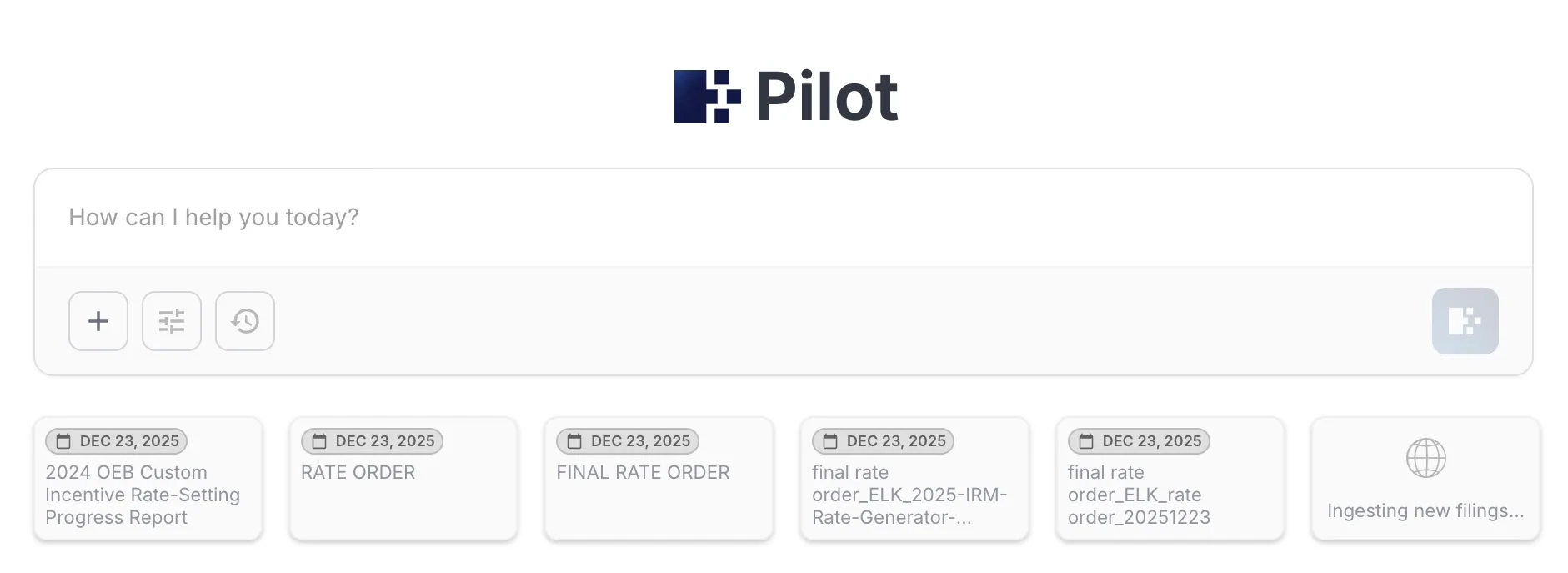
Regulatory Agent Lite
- Docket research 🇨🇦 & 🇺🇸
- Rate case analyzer to support drafting.
Use case Excel
- Access to the complete list of 100+ AI use cases that utilities across North America are employing, and the data leveraged.


Case study: InnPower
InnPower is one of the fastest-growing electric utilities in North America, serving a 292 km² service territory.
This includes over 10,000 poles, nearly 1,000 kilometres of power lines, and 10 distribution stations, each with a 44kV incoming voltage. They play a key role in connecting Innisfil & South Barrie, distributing electricity to homes, businesses, and industries in the area. InnPower is recognized as one of the most innovative companies in North America, consistently implementing new technologies to serve its customers as efficiently as possible.
Executive summary
In just a few months, InnPower transformed its engineering, regulatory, and customer service functions to leverage AI actively. Through Senpilot, InnPower leveraged AI across three distinct business functions.
These AI-driven initiatives have delivered over $1.2 million in annual cost savings and a 100% reduction in time back to teams. This has reduced cross-departmental data delays and created a unified foundation where every team can make smarter, faster AI-powered decisions.
Engineering agent
With Senpilot’s engineering agent, InnPower established a single, holistic view of its entire asset registry, from poles to transformers to feeders and substations, along with associated financial data. This is all accessible through plain-English queries. Instead of jumping between multiple asset systems, spreadsheets, and GIS layers, engineering and operations teams can now access the information they need in seconds. The agent consolidates data, fills in missing context, and surfaces insights that previously required hours of manual cross-checking.
This shift has cut down the time engineers spend gathering, validating, and reconciling data across systems. This is often the most time-consuming part of capital planning and asset decision-making. It has also improved the consistency and transparency of asset evaluations, particularly when multiple departments must collaborate or address time-sensitive questions.
Teams are now using the engineering agent across several core workflows, including:
- Holistic asset scoring and search
Engineers can evaluate asset health, risk, and performance by asking questions in plain English and pulling together condition data, work history, and financial attributes, without manual stitching. - Rapid project drafting
When planning replacements or system upgrades, staff can generate first-pass project drafts that include costs, asset dependencies, and work sequencing, accelerating early scoping. - Cross-system intelligence
By layering AI across GIS, EAM, OMS, and financial systems such as SAP, the agent provides a unified view that helps teams spot patterns, understand trade-offs, and make decisions with all relevant data on the table.
Regulatory agent
The Regulatory team adopted Senpilot’s regulatory agent, which enables them to converse with it in real time and to highlight precedents, historical filings, and interpretations of complex compliance questions backed by sources from the Ontario Energy Board (OEB). What started as a research tool has quickly become part of the daily regulatory workflow. This shift has shortened reporting cycles, reduced the time needed to assemble evidence packages, and brought more consistency across departments, not just in regulatory. This is especially true during rate case preparations and intervenor feedback. It has also created a shared source of truth, enabling regulatory, legal, and operations teams to work from the same set of precedents rather than rebuilding context each time.
Beyond rate cases, teams are using it across several routine workflows, including:
- Drafting evidence packages
Teams generate first-pass summaries of past rulings, build side-by-side comparisons of similar cases, and surface relevant interrogatories from prior years. - Preparing for regulatory hearings
Staff run test Q&A sessions with the agent to anticipate likely challenges from intervenors, drawing on real historical patterns.
- Early compliance checks
When new internal initiatives are proposed, the agent provides quick assessments of alignment with OEB guidelines, saving weeks of manual research.
Customer service agent
InnPower’s customer service team launched AI copilots in Q1 2026, and they have quickly become integral to frontline operations. Instead of juggling multiple systems, searching through account histories, or drafting explanations on the fly, agents now work with an assistant that automatically provides the proper context. The copilots provide consistent answers, reduce handle times, and help newer staff ramp up faster. This is especially useful during seasonal spikes in customer contact. Customers are already noticing the difference: fewer transfers, shorter wait times, and more precise explanations across billing, outages, and service requests. Internally, supervisors report fewer escalations and more predictable day-to-day service quality.
The team has built out several high-impact workflows, including:
- Storm-related call surges
During significant weather events, the AI agent helps triage calls, identify outage clusters, and route priority issues while providing instant status updates to customers. - Billing and payment issues
Agents can access complete histories, flag usage anomalies, and generate clear explanations in seconds, which reduces callbacks and customer frustration. - New service requests
For new connections or upgrades, the system guides both the agent and the customer through required steps, timelines, and documentation, minimizing follow-ups and incomplete submissions.
Goals
InnPower’s board of directors and executive team sought a solution that would:
- Enable all teams to manage higher-order tasks on their grid by leveraging AI
- Move as much spend from OPEX to CAPEX (consulting spend)
Results and benefits
InnPower went from pilot tests to integrating AI Agents in a year. This transformation was powered by activating three AI agents: Engineering, Regulatory, and Customer Service, which streamlined workflows across the organization. This quickly became a company-wide shift in how decisions, compliance reviews, and customer interactions were managed.
The initiative also produced a significant financial impact. InnPower realized $1.2 million in annual savings while achieving 100% time savings on several manual tasks across all teams. Beyond the efficiency and cost benefits, the organization’s operational model evolved to be more autonomous, predictable, and data-driven.
Key benefits included
- AI fluency
Activated three autonomous AI agents (Engineering, Regulatory, and Customer Service) that operate continuously across departments - Cost savings
Reduced third-party support and manual review costs, resulting in $1.2M in direct annual savings - Time efficiency
Eliminated redundant workflows, enabling teams to focus on higher-order tasks, delivering 100% time savings across multiple functions. - Scalability
AI agents dynamically scaled operations during peak demand periods without additional human intervention - Decision speed
Teams’ time to decisions accelerated from weeks and months to days, improving responsiveness and compliance accuracy - OPEX to CAPEX Shift
Consolidated recurring contractor expenses into a one-time AI investment, generating sustained capital value - Customer experience
AI reduced average response times by 95%, driving measurable improvements in satisfaction scores - AI leadership
Established their spot as one of the fastest-moving utilities to reach enterprise-grade AI adoption, setting a new benchmark for digital transformation
Client testimonial
Before Senpilot, we were spending nearly $400k on external consultants per major engineering project. I always knew AI could change that, but our data was the roadblock. Once Senpilot streamlined our data and enabled our AI engineering agent, everything fell into place. What used to take weeks now takes seconds, and we’ve expanded into more use cases without adding headcount.
 AdamEng Director @Innpower

With Senpilot, we went from idea to three fully operational AI agents in months. The $1.2M savings were immediate, but the bigger win is how our teams now operate: faster, smarter, and completely data-driven.
 DannyCEO @ InnPower

Senpilot
150 East Liberty St, Toronto, Canada
195 Montague St, Brooklyn, US
senpilot.com
Get in touch
Want to see how we can help you leverage AI?
Reach out here:
+1 (888) 574-8076